
THE SILICON SEVEN
A Complete Guide to the Semiconductor Supercycle

If you want to understand the future of the global economy, you have to stop looking at stocks as individual tickers and start looking at them as a supply chain. In the world of AI and Robotics, there is a “Silicon Hierarchy.” Each company relies on the one before it to exist.
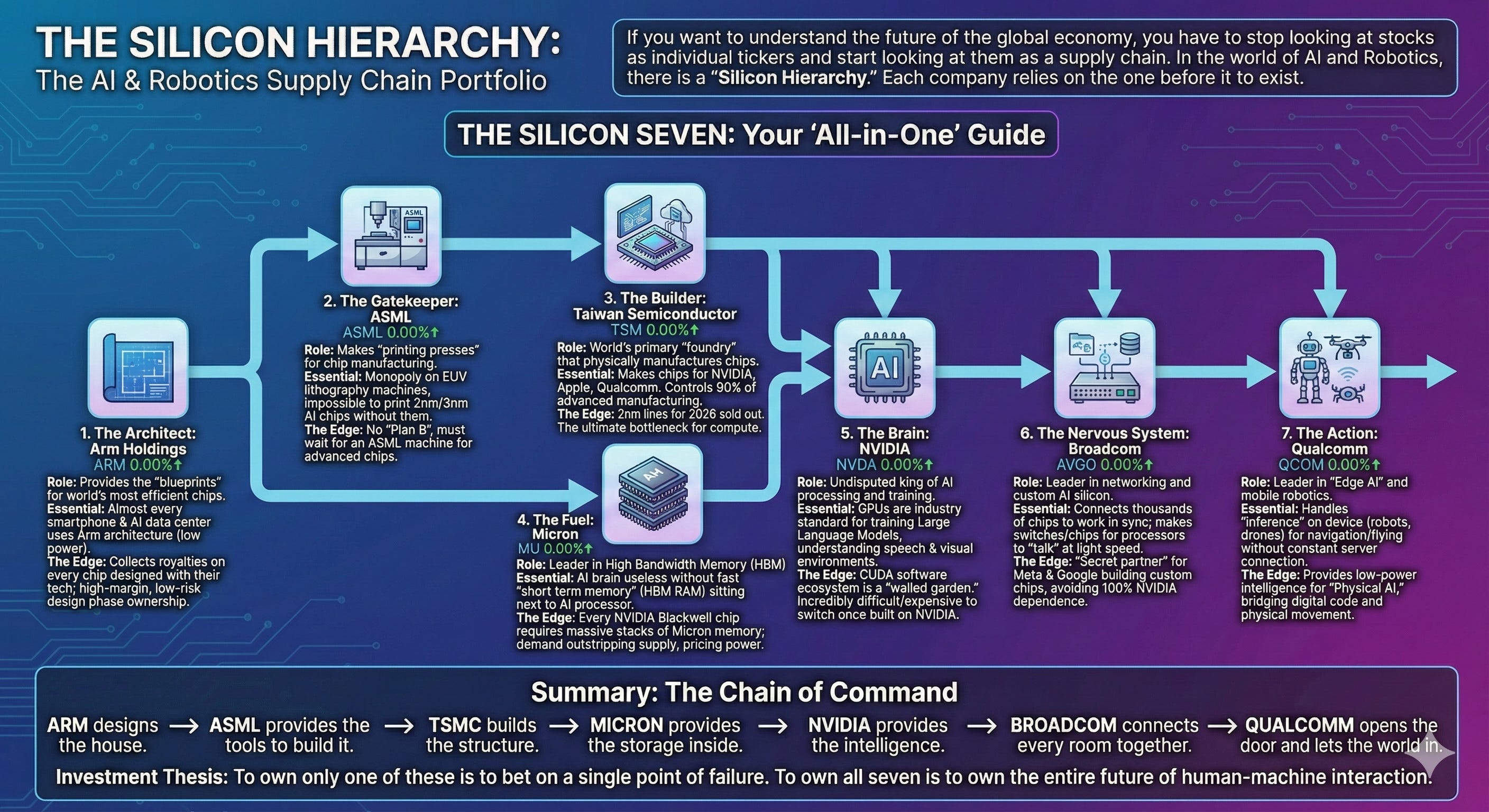
To build a portfolio that survives 2026 and beyond, you need to own the entire chain. From the first line of code in a chip’s design to the moment a robot arm picks up a tool, these seven companies control the flow of progress.
Here is your “All-in-One” guide to the Silicon Seven.
1. The Architect: Arm Holdings ARM 0.00%↑
The Role: Arm provides the “blueprints” for the world’s most efficient chips.
Why it is essential: Almost every smartphone and an increasing number of AI data centers use Arm architecture because it consumes significantly less power than traditional chips. In robotics, where battery life and heat management are everything, Arm is the invisible foundation.
The Edge: They do not make chips: they collect royalties on every chip designed using their tech. It is a high-margin, low-risk way to own the design phase of the cycle.
2. The Gatekeeper: ASML ASML 0.00%↑
The Role: ASML makes the “printing presses” that allow chips to be manufactured.
Why it is essential: They hold a literal monopoly on EUV (Extreme Ultraviolet) lithography machines. Without these machines, it is physically impossible to print the 2nm and 3nm chips that drive AI.
The Edge: There is no “Plan B” for the industry. If you want advanced chips, you have to wait in line for an ASML machine.
3. The Builder: Taiwan Semiconductor TSM 0.00%↑
The Role: The world’s primary “foundry” that physically manufactures the chips.
Why it is essential: TSMC makes the chips designed by NVIDIA, Apple, and Qualcomm. They control over 90% of the advanced manufacturing market.
The Edge: Their 2nm production lines for 2026 are already reportedly sold out. They are the ultimate bottleneck: nothing happens in the world of compute without TSMC.
4. The Fuel: Micron MU 0.00%↑
The Role: The leader in High Bandwidth Memory (HBM).
Why it is essential: An AI brain is useless without a “short term memory” fast enough to keep up with it. High Bandwidth Memory is the specialized RAM that sits right next to the AI processor.
The Edge: Every single NVIDIA Blackwell chip requires massive stacks of Micron’s memory. Demand is currently outstripping supply, giving Micron incredible pricing power.
5. The Brain: NVIDIA NVDA 0.00%↑
The Role: The undisputed king of AI processing and training.
Why it is essential: NVIDIA’s GPUs are the industry standard for training the Large Language Models that allow robots to understand human speech and visual environments.
The Edge: Their software ecosystem (CUDA) is a “walled garden.” Once a developer builds their AI on NVIDIA, it is incredibly difficult and expensive to switch to a competitor.
6. The Nervous System: Broadcom AVGO 0.00%↑
The Role: The leader in networking and custom AI silicon.
Why it is essential: A single chip cannot power a robot or a data center. Thousands of chips need to work in perfect sync. Broadcom makes the switches and networking chips that allow these processors to “talk” to each other at light speed.
The Edge: They are the “secret partner” for companies like Meta and Google who want to build their own custom chips to avoid being 100% dependent on NVIDIA.
7. The Action: Qualcomm QCOM 0.00%↑
The Role: The leader in “Edge AI” and mobile robotics.
Why it is essential: While NVIDIA handles the heavy training in the cloud, Qualcomm handles the “inference” on the device. Their chips allow a robot to navigate a warehouse or a drone to fly through a forest without needing a constant connection to a server.
The Edge: They provide the low-power intelligence required for “Physical AI.” They are the bridge between the digital world of code and the physical world of movement.
Summary: The Chain of Command
ARM designs the house.
ASML provides the tools to build it.
TSMC builds the structure.
MICRON provides the storage inside.
NVIDIA provides the intelligence.
BROADCOM connects every room together.
QUALCOMM opens the door and lets the world in.
Investment Thesis: To own only one of these is to bet on a single point of failure. To own all seven is to own the entire future of human-machine interaction.
Super article. Happy New Year. My man. Love your stuff.